Persona Library
Ummânu — the Enterprise AI Workforce Instrument — specifies an enterprise delivery organisation as 184 AI personas across 19 tiers. A workforce you can audit, not a prompt you can admire.
personas across 19 tiers, each with a paste-ready system prompt
carry numbered deterministic gates (Level 5 and 6)
regulated-practice regimes fenced as behavioural constraints
refusal rule on every persona: name the missing input; label the output UNVERIFIED
Counted from Ummânu Persona Library V22 (8 September 2026). Source: S1.
An AI role invented from first principles is a plausible-sounding fiction. Every one of Ummânu’s 184 roles is instead researched against live labour-market evidence — postings and occupational data collected for the role, the recurring functions extracted, the listing language preserved — and carries its Sources Consulted block, so a claim about what a persona does is a claim about what the job is, verifiable outside the library.
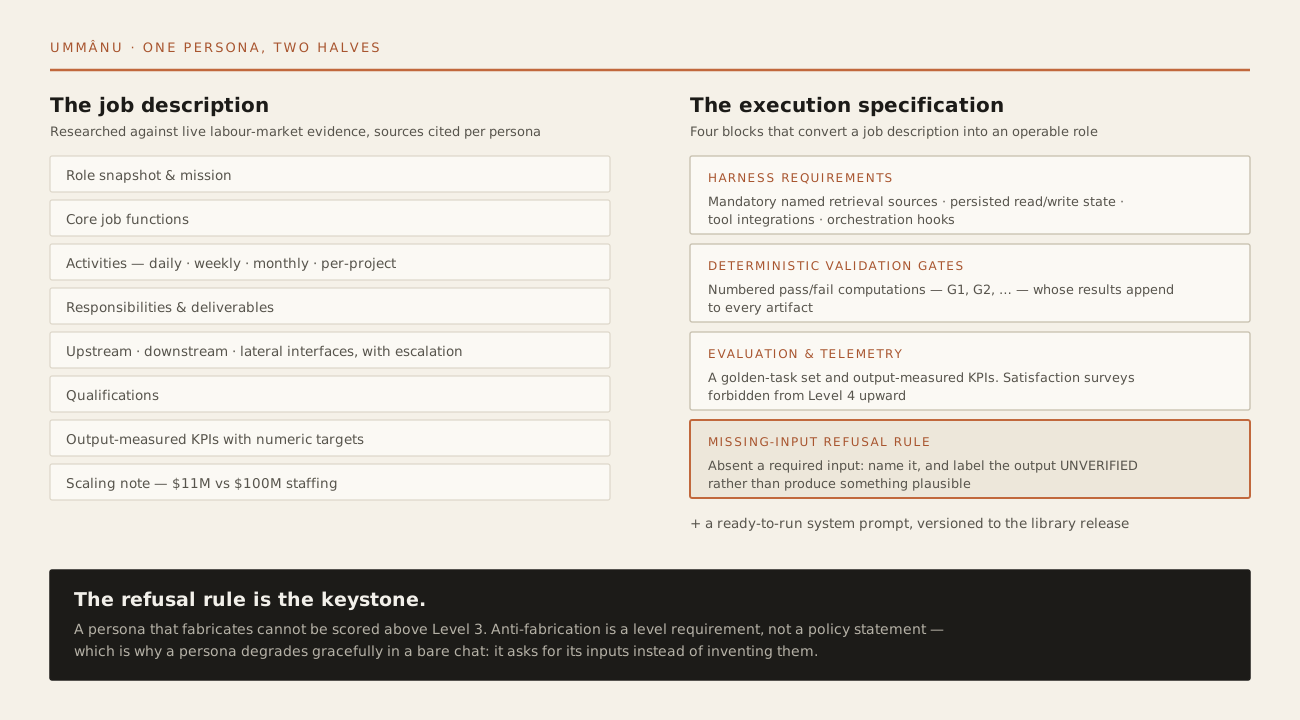
Each persona has two halves. The job description: role snapshot, mission, core functions, activities by cadence, responsibilities and deliverables, named upstream, downstream and lateral interfaces with escalation paths, qualifications, output-measured KPIs, and a scaling note. And the execution specification, in four blocks: harness requirements naming mandatory retrieval sources and persisted state; numbered deterministic validation gates that compute pass or fail; evaluation and telemetry with a golden-task set and output-measured KPIs; and a missing-input refusal rule — absent a required input, the persona names it and labels its output UNVERIFIED rather than producing something plausible.
VIEWPOINT (Persona 81) diffs every element and relationship name on a diagram against the repository export and fails on any mismatch, with the count reported. Review guidance cannot fail; a gate can.
Each persona declares its interfaces and escalation paths; every edge is reciprocal, so a handoff declared by one persona and not received by another is a defect.
A persona that fabricates cannot be scored above Level 3. Anti-fabrication is a level requirement, not a policy statement.
| Tier group | What it covers |
|---|---|
| Delivery, engineering and corporate (1–7) | Delivery and requirements; architecture; security and compliance; legal and governance; business and strategy; finance; corporate and people |
| Specialty hardware and integration (8–10) | Defence and intelligence IT, uncrewed systems; hardware-software integration; construction |
| Design, visualisation and operations (11–13) | Design and visual engineering; the diagram platform; deployment and cloud operations — the deepest tier, at 33 personas |
| Comprehension and science (14–15) | Comprehension and communication; mission science and programme specialists |
| Regulated practice (16–19) | Quebec construction-dispute legal team; Quebec regulated construction professions; clinical psychology advisory council; a Canadian accounting firm at 25 personas |
The nineteen tiers. Source: S1.
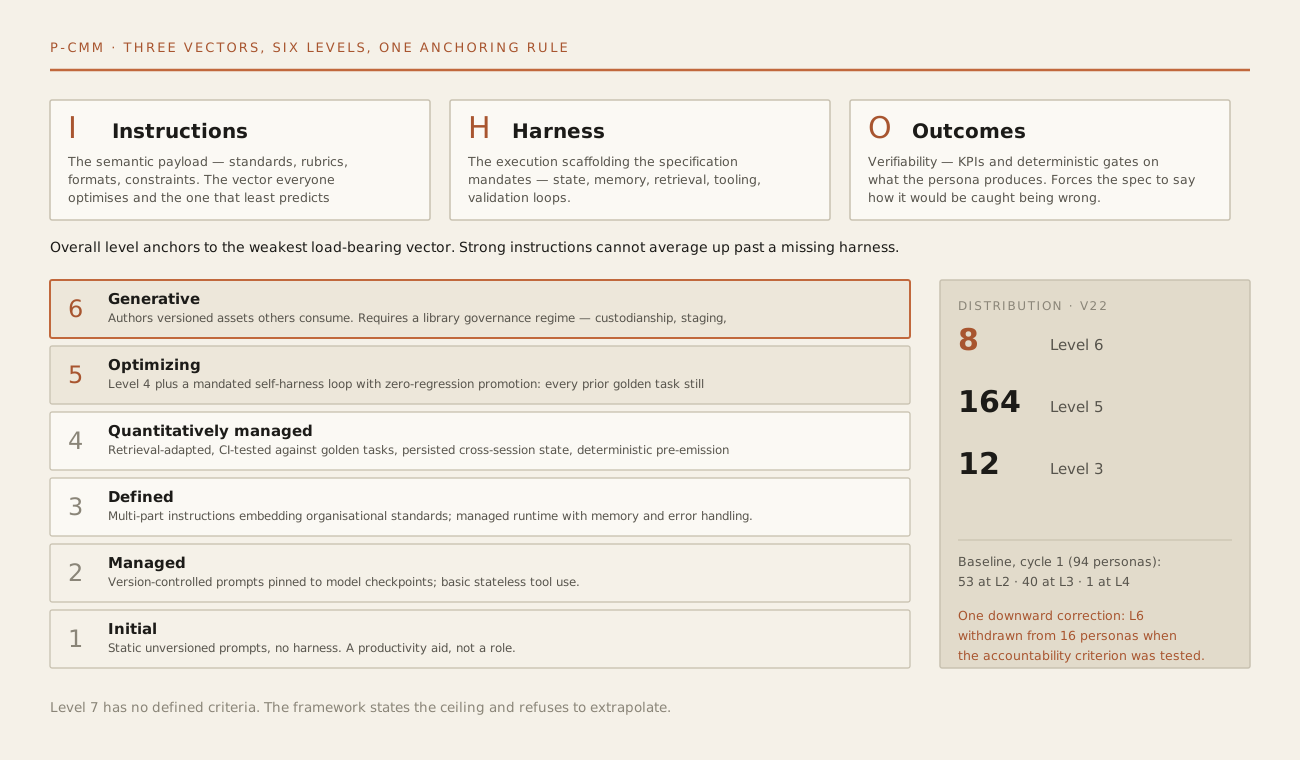
Every persona is scored on the P-CMM — a six-level, three-vector instrument that answers a procurement question no prompt review can: how much can be handed to this role without a human checking the output? The three vectors are Instructions, Harness and Outcomes, and the overall level anchors to the weakest load-bearing vector. Strong instructions cannot average up past a missing harness. Surveys are forbidden as KPI sources from Level 4 upward; KPIs are computed from persona outputs and retained registers, so the assessment is reproducible by a third party holding the same logs.
Across three assessment cycles the population grew from 94 to 184 personas and the distribution moved from 53 at Level 2, 40 at Level 3 and 1 at Level 4 to 8 at Level 6, 164 at Level 5 and 12 at Level 3. It also moved down once: when the Level 6 accountability criterion was challenged, the certification was withdrawn from sixteen personas rather than defended. Level 7 has no defined criteria; the framework states the ceiling and refuses to extrapolate.
Where a role touches reserved professional acts, the fence is a behavioural constraint the persona cannot cross in any configuration — not a disclaimer.
| Tier | Regime | The fence |
|---|---|---|
| 16 — Quebec construction-dispute legal team | Barreau du Québec | Privileged drafts for a supervising avocat. Persona 147 carries a no-override gate forbidding any document counsel would sign. |
| 17 — Quebec regulated construction professions | OIQ · OTPQ · OAGQ | Analyses and drafts to be verified, signed and sealed by a licensed member of the order. |
| 19 — Canadian accounting firm | CPA reserved practice | Assurance, insolvency and valuation acts fenced to licensed CPAs; a source air-gap between regulatory and firm agents. |
| 18 — Clinical psychology advisory council | Clinical-safety doctrine | Advisory and educational only. A hard patient-safety gate halts and routes to emergency services. |
The Quebec construction-dispute doctrine was benchmarked against ten validated Quebec construction-defect judgments: eight matches, one partial, one match-by-refusal. The benchmark then changed the doctrine — four corrections were adopted. An external benchmark that can overturn your own specification is what makes a fenced regime credible to the order that regulates it. Dinanu — the Legal implementation of Nabu — works inside exactly this boundary.
Source: S1, Tiers 16–19; ten-judgment benchmark.
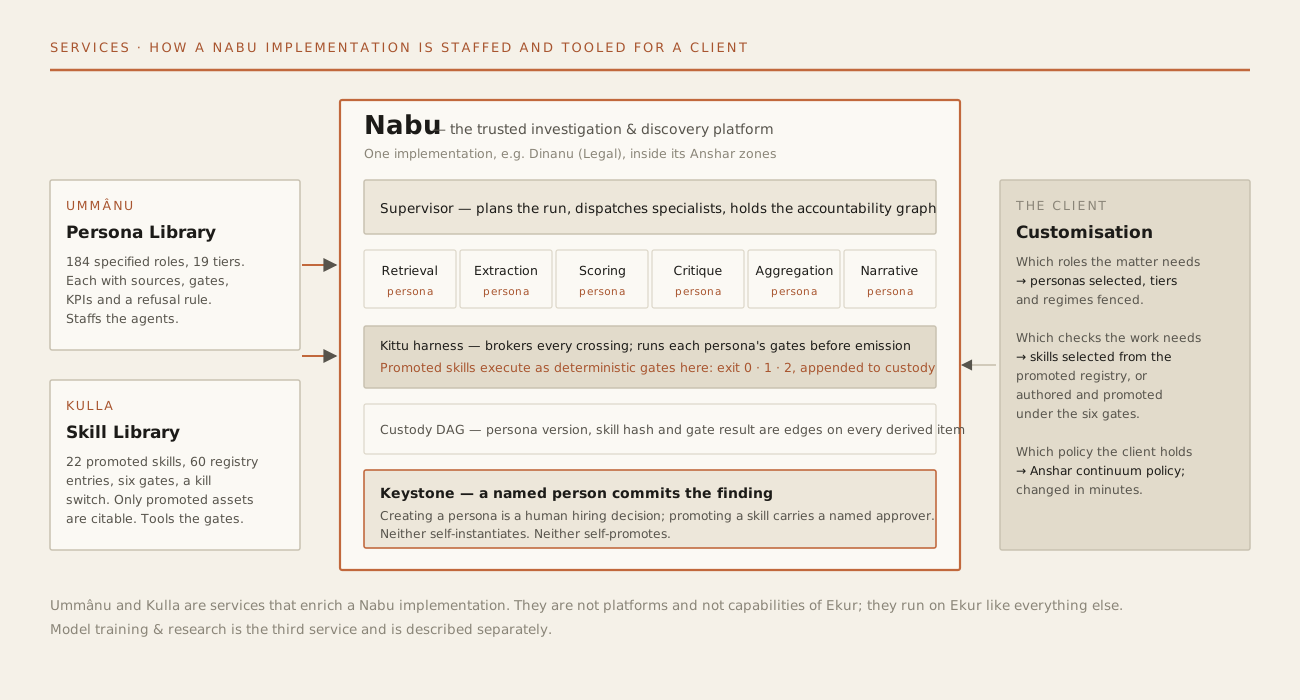
Ummânu is how a Nabu implementation is staffed for a client. The persona is the agent’s specification; the platform is what enforces it. A persona’s named retrieval sources become the governed library registry it may draw from. Its numbered gates become pre-emission checks under the Kittu harness — and where a gate exists as a promoted Kulla skill, the skill runs and its result appends to custody. Its refusal rule becomes Nabu’s honest gap. Its declared interfaces become the supervisor’s dispatch graph. Its regulated-practice fence becomes a no-override gate inside the sector implementation that cannot be relaxed by configuration. And creating a persona remains a human hiring decision: no persona self-instantiates.
Customising Nabu for a client is therefore a selection, not a rewrite: which roles the matter needs, which tiers and fences apply, and which client policy the continuum holds. The persona’s version is an edge on every item it produces, so a finding can be traced to the role specification that produced it — and to the labour-market sources that specification cites.
Responsible-AI practice
- Anti-fabrication is structural: a persona that fabricates cannot be scored above Level 3.
- Human decision authority is preserved: no persona self-instantiates; consequential changes carry named ratification.
- Auditability is designed in: output-measured KPIs from retained logs and an append-only version history; released versions remain accessible, testable and auditable.
- Privacy is bounded: telemetry is de-identified before it is used to improve a persona; Canadian data residency.
- Frameworks: ISO/IEC 42001 A.5–A.7; TBS Directive on Automated Decision-Making; NIST AI RMF; ITSG-33 and WCAG.
Unsolved, and published
The best-practice standard retains an explicit unsolved-problems list: political and tacit constraints must be codified by humans; cross-diagram consistency depends on the ontology being maintained; hyper-dense layouts still require human spatial judgment; AI proposes and named humans dispose.
Out of scope: model selection, fine-tuning and hosting. Ummânu specifies roles, not the models that run them. Model training and research is a separate Enkidu service.
S1 — Enkidu. Ummânu — Enterprise Persona Library, Full Company Edition, V22. 8 September 2026.
S2 — Enkidu. P-CMM — Capability Maturity and Evaluation Framework for Autonomous AI Personas. Assessment cycles 1–3, 2026.
S4 — Enkidu. Ummânu — the Enterprise AI Workforce Instrument. Technical whitepaper ENK-TWP-2026-003, September 2026.