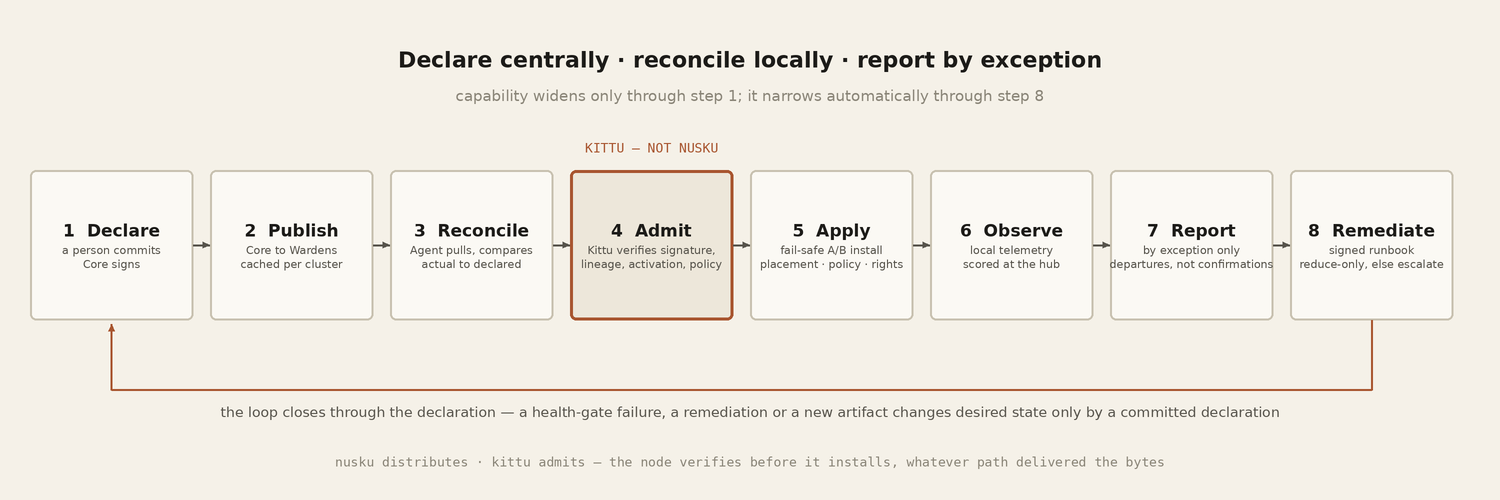
Nusku is Ekur’s fleet-control capability. Client operators declare what runs where, from one node to thousands. The control model is simple: declare centrally, reconcile locally, report by exception. A node that is dark for a day converges back to the declared state when connectivity returns.
Control messages carry no mission data. Nusku distributes; Kittu admits, so a compromised control component can at worst deliver an artifact the node refuses. Losing Nusku stops future changes. Each node keeps running its declared state. Enkidu publishes to a client’s Nusku and has no presence inside it.
Disconnection is a normal state, not a failure. A node dark for a day converges to the same state as one that never lost its link.
The management plane cannot become an exfiltration path — by construction, not by policy.
A compromised control-plane component can at worst deliver an artifact the node refuses. Movement is logistics, never trust.
Capability widens only through a committed declaration. It narrows automatically.
Total loss of the control plane leaves every node running exactly as declared.
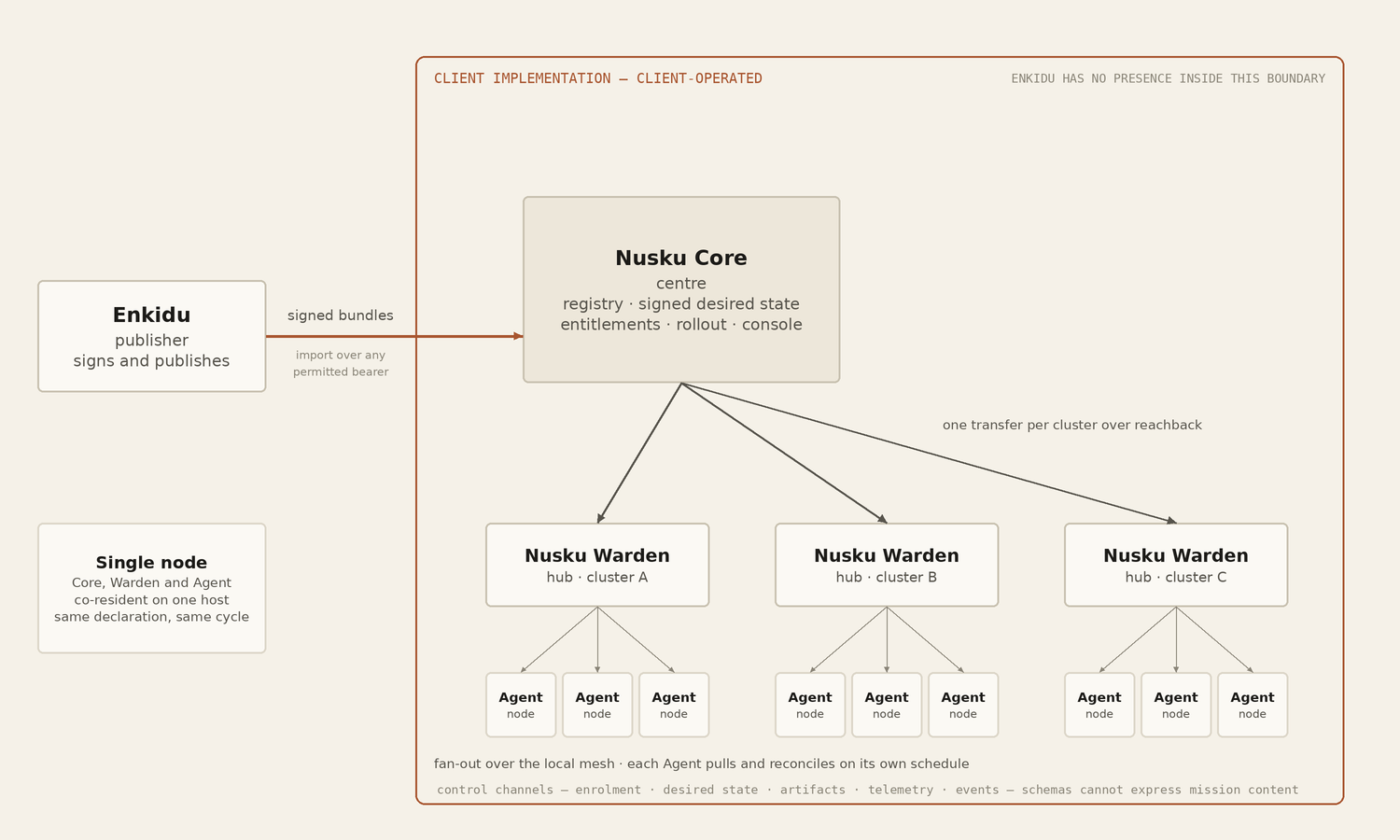
A single-node implementation runs all three on one host. Scale changes complexity, not function.
Enkidu publishes signed artifacts to a client’s Core and nothing more. Enkidu has no component, credential or channel inside the client’s implementation; administration inside it — and every model, agent, tool and policy the client authors for itself — is the client’s alone.
Anshar defines zones; Nusku places resources into them.
Kittu admits; Nusku distributes only what the registry has activated.
Shedu holds every key; Nusku carries the declaration of which algorithms and protocols apply, and never key material.
Nusku is specified and is being built to its specification. No availability, customer or performance claims.
mission-data bytes a Nusku channel can carry. Control schemas structurally cannot express mission content. Source: Enkidu (S2).