Kittu is the trust assurance capability of Ekur. Every trust claim is bound to a policy with an explicit threshold, reduced to a measurable outcome and carried by a signed, hash-linked chain of evidence. Evidence expires and must be re-earned. The same structure runs live: a zero-trust reference monitor sits at every boundary, so nothing an agent produces is trusted by default.
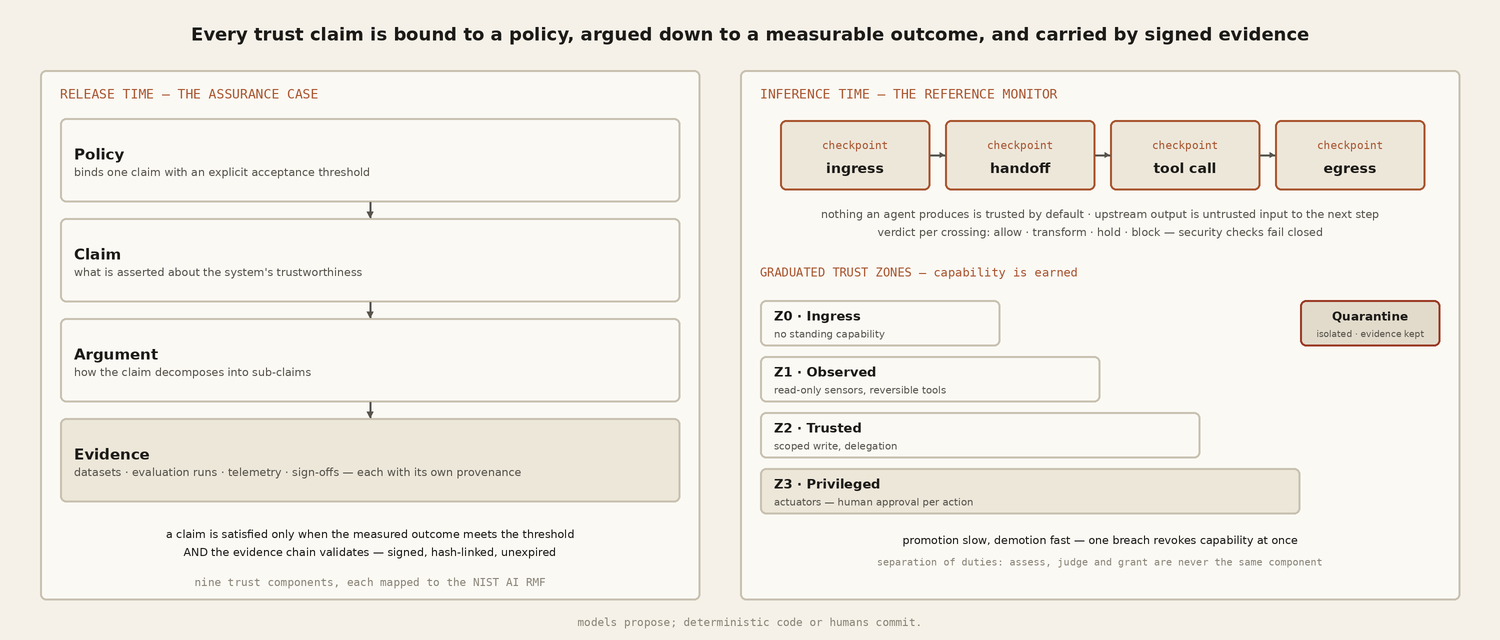
A claim is satisfied only when two conditions both hold: the measured outcome meets the policy’s threshold, and the supporting evidence chain validates — every signature verifies, no link is broken, nothing has expired.
Everything that supports a claim — datasets, model artifacts, evaluation runs, telemetry, security findings, human sign-offs — carries its own signed, hash-linked record of what was produced, how, and who is accountable. Evidence expires, so the system is forced to re-measure as the world changes.
At inference time a checkpoint sits at every boundary — where a request enters, where one agent hands off to another, where a tool is called, where output leaves — and brokers every crossing against policy. Upstream output is untrusted input to the next step; delegated authority never exceeds the authority that delegated it; security checks fail closed.
An agent starts with no standing capability and earns more through demonstrated behaviour. Promotion is slow; demotion is instant. Actuators and irreversible actions require a person’s approval per action.
The component that assesses an agent, the one that rules on its zone and the one that grants capability are never the same, so no agent — and no single compromised service — can promote itself.
Nine trust components, each mapped to the NIST AI Risk Management Framework:
Anshar defines the boundary; Kittu verifies every crossing of it.
Nusku distributes; Kittu admits — nothing installs or runs on a node that Kittu has not verified against policy and lineage.
Shedu answers who is acting and whether anything is intact, as signed evidence; Kittu decides whether to proceed. Shedu never renders a verdict; Kittu never holds a key.
Aligned to the NIST AI Risk Management Framework, ISO/IEC 42001, NIST SP 800-207 zero-trust architecture and the W3C PROV data model, so that a trust dossier is defensible to an external auditor, regulator or customer. Alignment is not certification.
Kittu is documented for client distribution and has been exercised end to end, together with Anshar, in a delivered engagement. No availability, customer or performance claims.
trust components assured, each mapped to the NIST AI RMF trustworthiness characteristics. Source: Enkidu (S4).