Anshar
Every operation can be decomposed into bounded zones with explicit entry and exit conditions. When boundary conditions are explicit, handoffs become contracts, failures become measurable, and improvement becomes systematic.
Anshar is the zoning and observability capability of Ekur. An operation decomposes into bounded zones, each with one goal, an explicit entry condition and an explicit exit condition. A connected set of zones that forms one end-to-end process is a continuum.
Policy answers one question: is this permissible? It does not describe how to do it. Failure is modelled explicitly, with a defined route back. Every boundary crossing is recorded, so observability nests from one zone to the whole. The other three capabilities enforce, administer and key the boundaries Anshar defines.
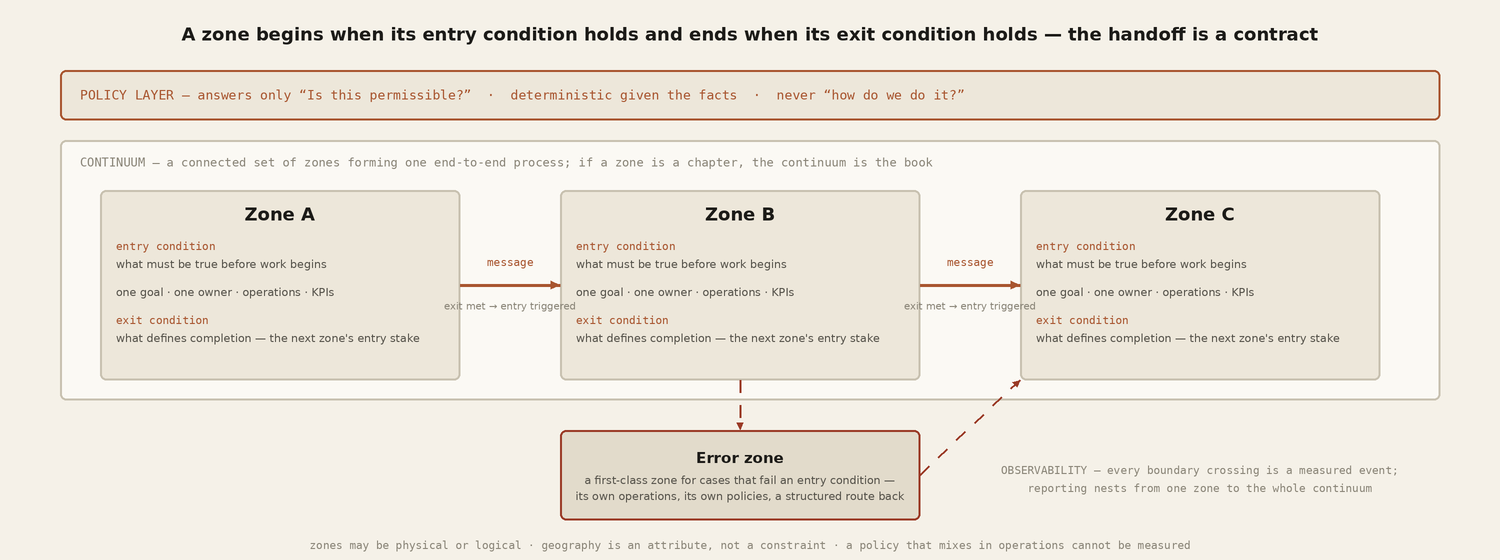
A bounded operational space defined by a single goal and explicit entry and exit conditions — physical, logical or both. Geography is an attribute, not a constraint.
A connected set of zones forming a complete end-to-end process. A continuum may span one zone or many; many continua may share a zone.
A policy answers only “Is this permissible?”, never “How do we do it?” Given the facts, a well-formed policy returns a deterministic decision, so it can be tested, audited and reported on independently of operations.
The formal signal that a zone’s exit conditions are met. It carries state to the next zone and triggers its entry, so every handoff is explicit.
Failure is a first-class zone with its own operations, its own policies and a structured route back into the main flow — never an ad-hoc exception.
Every boundary crossing is a measured event. Reporting nests from a single zone to the whole continuum to the organisation.
On an Ekur implementation, Anshar has two layers. The physical layer is the set of zones — groupings of the implementation’s own compute, where agents run and reach the tools, sensors and actuators available to them. The logical layer is the set of continua — the missions and workflows that run across zones and carry their own policy. A single-node implementation may be one zone and one continuum; a fleet may be hundreds of each.
Anshar defines the boundary; Kittu verifies every crossing of it.
Anshar defines the zone; Nusku places resources into it by declaration.
Anshar defines the zone and the continuum; Shedu makes each of them real in keys.
Anshar is documented for client distribution and has been exercised end to end, together with Kittu, in a delivered engagement. Specification and framework material; no availability, customer or performance claims.
question a policy answers: “Is this permissible?”, never “how do we do it?”. Source: Enkidu (S5).