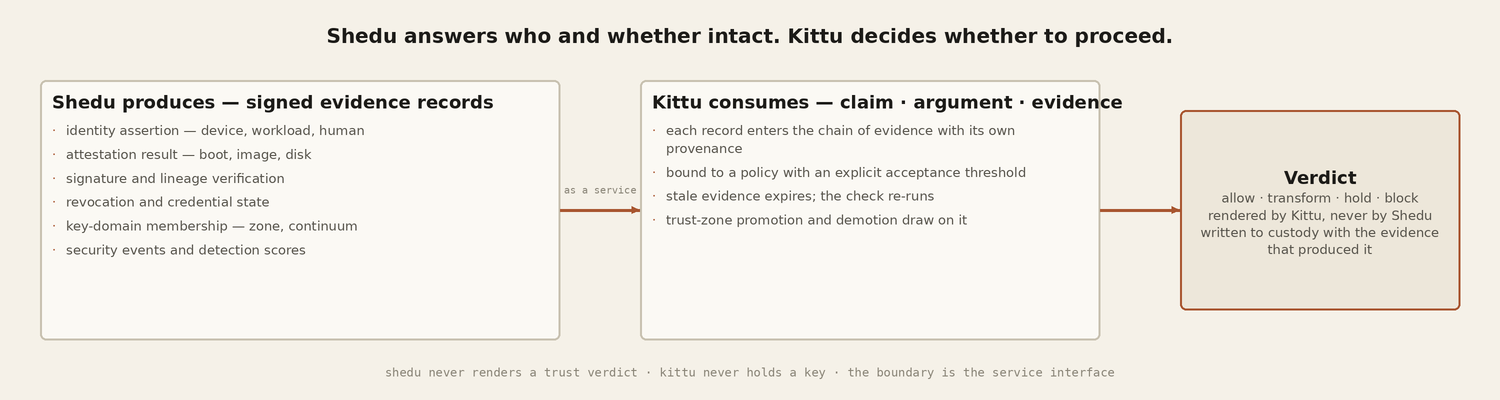
Shedu is the security control plane of Ekur: cryptography, identity and key custody, and the platform security measures that rest on them. It is what makes a node who it says it is, a link unreadable, an artifact unalterable and a record attributable — connected or not, and after capture. Shedu answers who is acting and whether anything has been read, forged, replayed or tampered with, and it answers in signed evidence that Kittu consumes as a service. It never renders a trust verdict. The name is Akkadian: the protective spirit at the gate. The lamassu watches; the shedu holds the door.
The classical public-key primitives in universal use are broken outright by a cryptanalytically relevant quantum computer, and traffic recorded today can be read the day one exists. What must migrate is every key establishment and every signature; symmetric cryptography is answered by size and is retained. Post-quantum migration now has deadlines. NSA’s CNSA 2.0 sets the ceiling for allied national-security systems. Canada’s ITSM.40.001 requires migration plans by April 2026, high-priority systems migrated by the end of 2031 and all systems by the end of 2035. Shedu is designed so that an implementation ships with no quantum-vulnerable link, rather than retrofitting one out later. The second half of the threat model is the environment: nodes that are carried, intermittently connected and sometimes captured, where a design that assumes a reachable authority fails in exactly the conditions it exists for.
Every session key rests on two independent exchanges, one classical and one post-quantum; a break of either leaves the link secure.
Each active algorithm is a finalised NIST standard, with a backup based on different mathematics; a cryptanalytic surprise is a policy change.
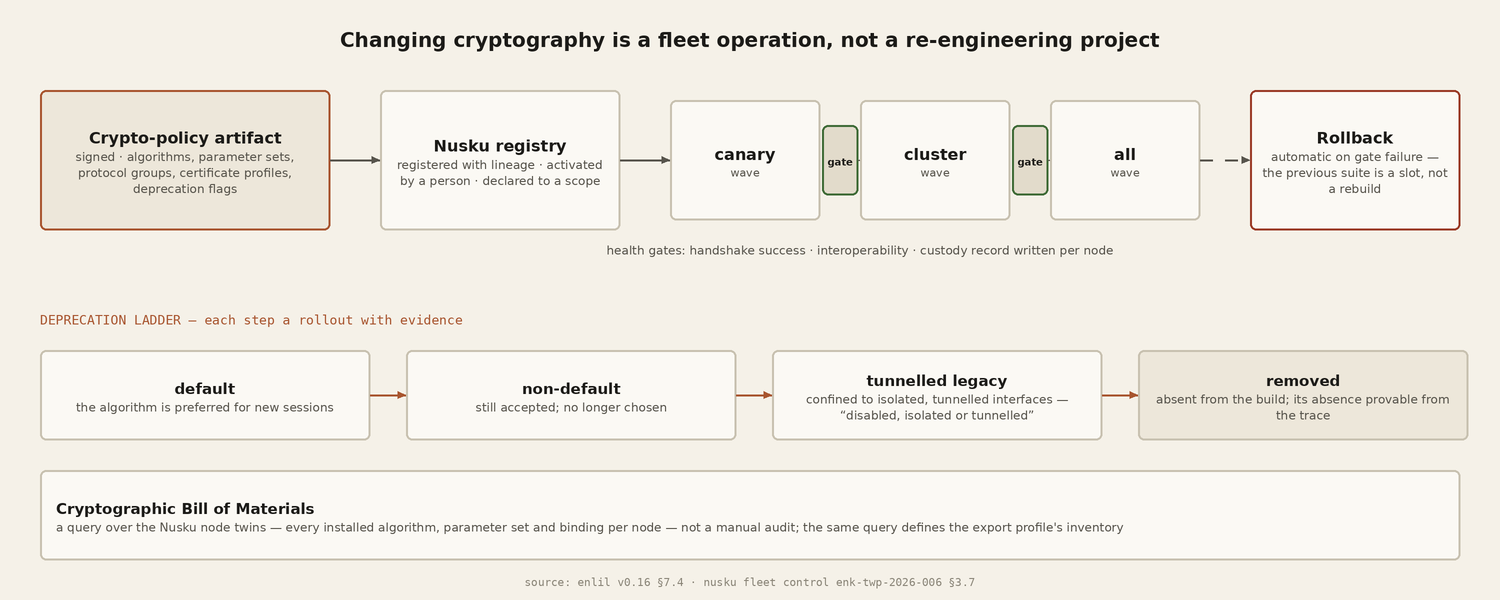
Changing cryptography is a fleet operation; the inventory is a query; deprecation is provable from the trace.
A node dark for weeks is still cryptographically itself, to every peer, without a round trip. No private key is ever in transit.
Every link is mutually authenticated and encrypted above whatever the radio, tunnel or carrier provides. A captured node is excluded cryptographically.
Whatever path delivered the bytes, the consumer verifies for itself — and a signature made today verifies identically in a decade.
A device’s key pair is generated inside its own hardware root of trust and never leaves it. Enkidu’s factory endorsement binds that key to the hardware; the client’s own authority issues the operational identity at installation. From that point the identity is the client’s. Enkidu holds two roots — the factory endorsement root and the publisher signing root — and nothing else; every operational key is created and held inside the client’s enclave. A node that is taken yields nothing: tamper signals zeroise the key store without waiting to be told, and the identity is revoked so that every peer refuses it.
The choices within the invariants — algorithm ceiling, identity bootstrap, revocation posture and more — are the client’s, declared through Nusku. The invariants are not.
Built on NIST FIPS 203, 204 and 205, NIST SP 800-208 stateful hash-based signatures, hybrid TLS 1.3 and DTLS 1.3 key establishment, and the zero-trust posture of NIST SP 800-207; aligned to NSA CNSA 2.0 and CCCS ITSM.40.001. Quantum key distribution is excluded, as CNSA 2.0 excludes it. Shedu is designed to use validated implementations of the standard algorithms where they are available; no cryptographic-module validation claim is made for Shedu itself.
Anshar defines the zone and the continuum; Shedu makes each real in keys.
Kittu decides whether a step may proceed; Shedu supplies the evidence and holds every key.
Nusku carries the declaration; Shedu executes what it says about keys and protocols, and never distributes anything itself.
Shedu is specified and is being built to its specification. Cryptographic items are export-controlled; export classification is determined with counsel. No availability, customer or performance claims.
independent key exchanges — one classical, one post-quantum — behind every session key on every link; a break of either leaves the link secure. Source: Enkidu (S3).
NVIDIA, Jetson, IGX, DGX and Blackwell are trademarks of NVIDIA Corporation. Claude, Gemini, Microsoft Copilot and LexisNexis are trademarks of their respective owners. Referenced for identification; no endorsement implied.