Skill Library
Kulla — the Governed Skill Production Instrument — is a production regime in which AI personas author reusable software assets that other personas and humans consume, under six gates with a named human approver, an append-only registry and a kill switch. Bricks stamped with the maker’s name.
promoted skills across five asset classes, by 14 authoring personas or pairs
registry entries recording every lifecycle transition, append-only
gates, all of which must pass; a 170-line harness re-runnable by a third party in about a minute
entries with a populated flaw record, including defects never externally visible
Counted from the Kulla Skill Library registry. Source: S3.
A Level 5 regression harms one persona. A defective promoted asset propagates silently into every consumer downstream. That asymmetry, not autonomy, is what makes generation a separate problem — and why promotion is a controlled, audited act rather than a save. Governance was stood up before the first asset was authored: a registry that begins after the first ten assets cannot evidence their provenance.
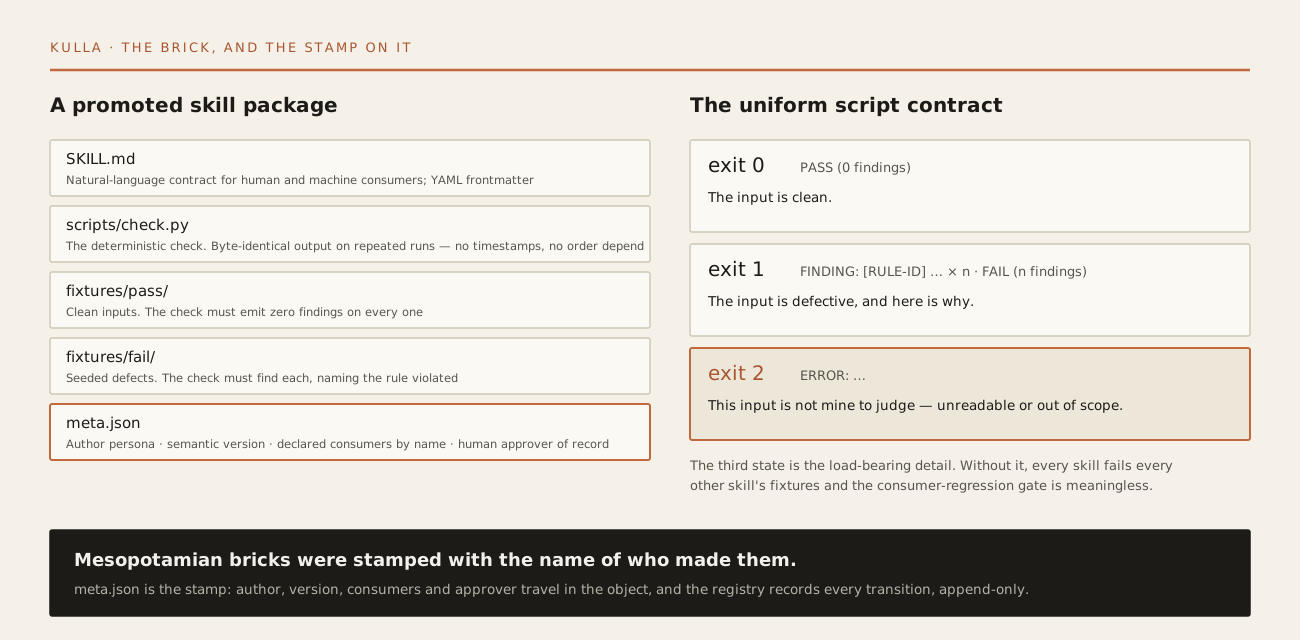
A promoted skill is a package: a natural-language SKILL.md contract for human and machine consumers; a deterministic check whose output is byte-identical on repeated runs; pass fixtures on which it must emit zero findings and fail fixtures on which it must find each seeded defect, naming the rule; and meta.json — the stamp in the object — naming the author persona, the semantic version, the declared consumers by name, and the human approver of record.
Every check obeys one script contract. Exit 0 with PASS when the input is clean. Exit 1 with one FINDING line per defect, each naming the rule violated. Exit 2 with ERROR on unreadable or out-of-scope input. That third state is the load-bearing detail: it lets the consumer-regression gate distinguish “this file is wrong” from “this file is not mine to judge”, and lets a consuming pipeline route an out-of-scope result correctly rather than record a false defect.
| Asset class | Skills |
|---|---|
| Notation and modelling validators | archimate-view-check · bpmn-method-style-lint · requirement-lint · sql-naming-lint · ontology-guard · cad-layer-check |
| Diagram platform | diagram-spec-validate · pptx-diagram-kit · vsdx-diagram-kit · dxf-construction-kit · raster-render-kit · svg-figure-check · whitepaper-to-spec · visual-critique · inventory-diagram-reconcile |
| Language and comprehension | readability-gate · genx-humanizer |
| Regulated-practice gates | mise-en-demeure-lint · setback-table-check · quatre-registres-lint · cca-schedule-check |
| Library custodianship | registry-audit |
Twenty-two promoted skills. Custodian: REGISTRY (88). Source: S3.
Staging, gate tests, human approval, promotion, deprecation, retirement. Nothing is consumed from staging; all six gates pass or nothing is promoted.
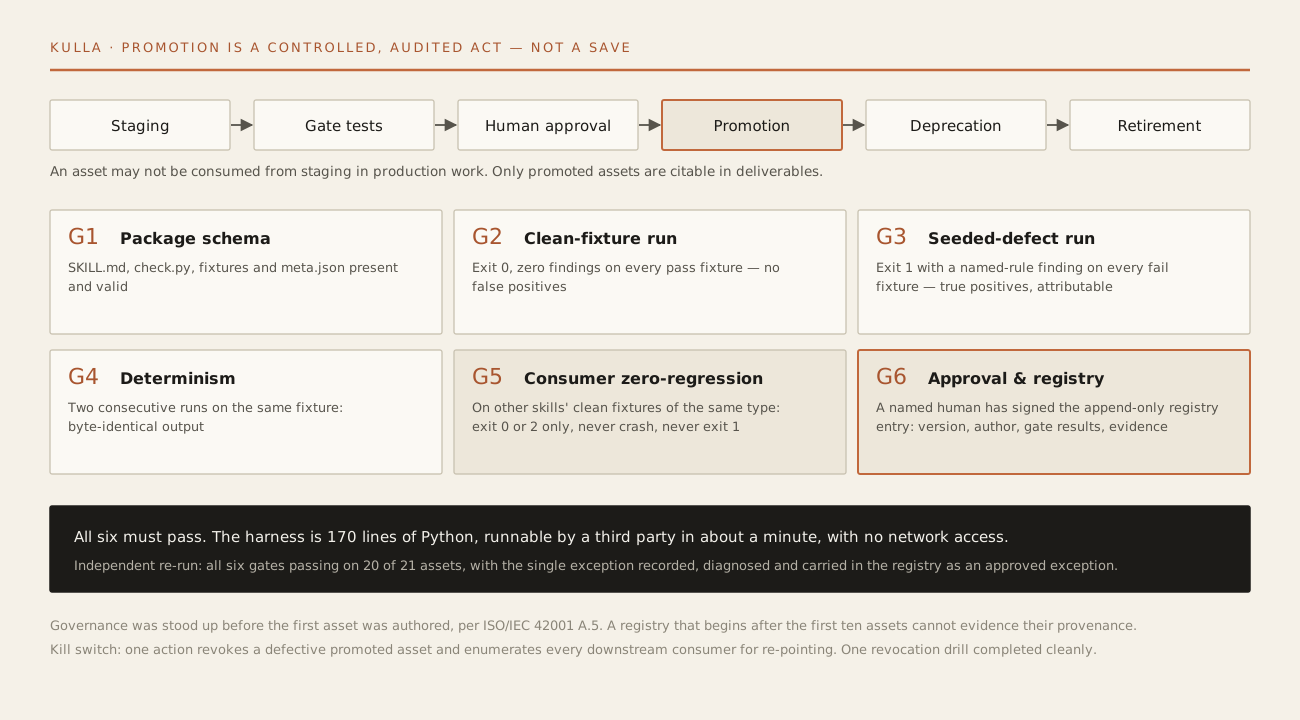
Each skill’s check is fed every other skill’s clean fixtures of the same file type: exit 0 or 2 only, never crash, never exit 1. Declaring consumers by name is a G1 requirement, not a courtesy.
A named human signs the append-only registry entry — version, author, gate results, evidence. No asset self-promotes. The persona proposes the asset; a person commits it.
The custodian audits its own library. The registry-audit skill checks the registry that records registry-audit; on its first live run it produced eight false positives — its strict-increase rule rejected legitimate same-version transitions from staged to promoted — and the rule was corrected. A governance tool that finds a fault in the governance it enforces, on its first live run, is the strongest available evidence that the loop is real rather than decorative. One action revokes a defective promoted asset and enumerates every downstream consumer for re-pointing; one revocation drill has been completed cleanly.
Thirteen registry entries carry a populated flaw record — defects found in authoring, gate runs and live use, with the fix and the version bump. Including flaws that were never externally visible.
| What happened | What it demonstrates |
|---|---|
| requirement-lint, fed a file with zero valid requirement lines, exited 1 with findings instead of exiting 2 as wrong file type. Found in an independent gate run; fixed in a patch release. | A gate caught a real behavioural defect — an out-of-scope file being judged rather than declined. |
| registry-audit produced eight false positives against the library’s own registry on its first live run. The rule was corrected to non-decreasing with duplicate detection. | The custodian audited the library and found the library wrong. |
| Edge labels colliding with node shapes were fixed once in the shared layout engine; the fix is recorded against the originating kit and referenced from the two kits that consume it. The residual limit is recorded, not closed. | A defect fixed once, propagated to every affected consumer. |
| An independent re-run found a consumer-regression failure in visual-critique: two skills held different definitions of a clean input. The finding was recorded, not removed; the tooling gained an approved-exception status. | A governance system that produces a new, correctly scoped status in response to outside criticism. |
Source: S3, flaw records; independent harness re-run.
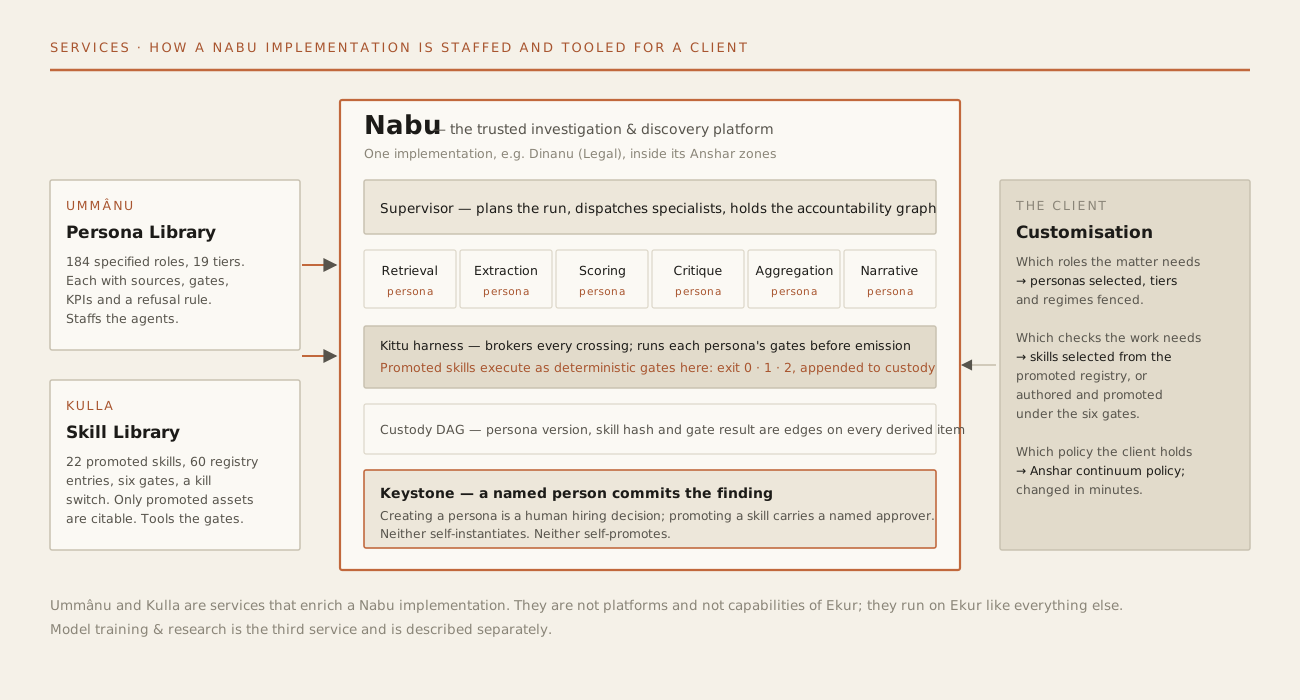
Kulla is how a Nabu implementation is tooled for a client. A promoted skill is a deterministic gate; its exit code is a fact in the custody record. A Nabu pipeline may load a skill only from the promoted registry — staging is unreachable from production continuums. Exit 0 passes; exit 1 attaches named-rule findings to the item and holds it; exit 2 routes the item as out of scope rather than recording a false defect. The skill’s hash, version and approver are edges on every item it gated, so a finding can be traced to the exact check that passed it and the person who promoted that check. Declared consumers make the blast radius of a revocation known before it happens.
Regulated-practice gates carry their limits with them. mise-en-demeure-lint runs inside Dinanu and checks form, not substance: a pass means the draft carries the structural elements a formal notice needs, not that it should be sent. And a client’s own validation rule — a house style, a filing convention, a regulatory schedule — becomes a promoted skill with fixtures, a registry entry and an approver; from then on its result is a fact any reviewer can re-run.
Independent verification
The library ships the governance document, the executable gate harness, every skill package with its fixtures, and the registry. Running the harness against the promoted library takes approximately one minute and requires no network access. An independent re-run returned all six gates passing on 20 of 21 assets, with the single exception recorded, diagnosed and carried in the registry. Ecosystem baseline at cycle 1: 76 declared consumer links across 20 of 21 skills; 21 of 21 skills and 89 of 89 fixtures passing; zero capability defects escaped to external review.
The bright line
Generated assets never auto-instantiate personas. A drafted persona specification is advisory and terminates in a human hiring decision. No asset self-promotes; every promotion carries a named human approver and the authorisation under which they signed. Governance preceded generation, per ISO/IEC 42001 A.5; released component versions remain accessible, testable and auditable; telemetry is de-identified before it enters a shared asset.
Limits: a skill checks what its rules encode. The regulated-practice gates check form, not substance, and say so in their contracts. One approved exception is carried in the registry. Level 7 has no defined criteria.
S3 — Enkidu. Kulla — Skill Library: GOVERNANCE.md, run_gates.py, registry.json. 2026.
S2 — Enkidu. P-CMM — Capability Maturity and Evaluation Framework for Autonomous AI Personas. Assessment cycles 1–3, 2026.
S5 — Enkidu. Kulla — the Governed Skill Production Instrument. Technical whitepaper ENK-TWP-2026-004, September 2026.