Home/Sectors/Defence/Lamassu — IDEaS Proposal
IDEaS Competitive Projects · Urban Sensing

Lamassu

Ambient urban sensing from the city’s own sensors — an AI middleware platform that fuses already-existing cameras, acoustic arrays, environmental monitors and RF-capable infrastructure into real-time, explainable threat indicators, without installing a single new sensor.

Conceptual architecture PDF All editions →
Lamassu
Urban Sensing
Turning urban data into insight
Design phase
Component · TRL 4 → 6
12 months
Witnessed slice at month 12
Zero new sensors
Already-existing feeds only
Sovereign
Canadian-owned IP

The city is already sensing — nobody is listening

02 — The challenge

Cities already operate thousands of cameras, acoustic arrays, air-quality monitors, vibration sensors and RF-capable infrastructure — continuous data streams currently unexploited for defence situational awareness. Today the practical options are purpose-built sensor deployments — costly, slow, geographically limited — or nothing at all. Commercial smart-city analytics favour breadth over defence-grade auditability: they typically lack signed provenance, deterministic enforcement, or a chain of evidence sufficient for operational trust.

The core problem is exploiting the sensor infrastructure that already exists, at defence-grade reliability and explainability, without new procurement — a sovereign capability Canada currently sources from no domestic supplier.

Mission archetypes
Urban counter-UASRF + EO
Critical-infrastructure anomalyOT + vision
Environmental early warningEnv + acoustic
Strategic anchors
CAF Digital Campaign Plan · Strong, Secure, Engaged · urban defence priorities

Two tiers, one adjudicated picture

03 — The proposal

Site IFCs — one per service area — ingest directly from already-existing sensors through a signed connector model speaking ONVIF, MQTT, SensorThings, NGSI-LD, OPC-UA and DDS. Sensor-specialist micro-models across vision, acoustic, RF, spatial and environmental modalities propose candidate observations; a site coordinator composes them; and the site’s deterministic adjudication engine — never a model — commits the regional indicator.

A single Central IFC correlates across every site with larger models, fine-tunes the deployed roster, and holds corporate memory. If the reachback link is cut, a Site IFC keeps ingesting, inferring and committing under local authority, and reconciles when the link returns. Every committed indicator carries a machine-readable confidence and resolves, through a signed trace tree, to its source observations.

A portable Site IFC deployment profile — a containerized build of the compute tier for ruggedized field compute or a cloud-edge instance — targets operational readiness against local feeds within hours, not weeks.

The adjudication contract
Propose Compose Commit

Models propose and compose; only the deterministic engine commits — no alert is ever gated purely on model confidence.

Validation without government data

DND/CAF supplies no data, and the plan assumes none. The phase generates synthetic and lab-representative multi-modal datasets, prototypes each target protocol against representative implementations, and validates findings against multiple independent synthetic sources to bound overfitting.


Built on the Enkidu edge-AI stack

04 — Building blocks

Lamassu composes the same Enkidu platform as Northwind — its two-tier pattern recast for civilian infrastructure. Two frameworks are in scope for this design phase; two companion subsystems sit beyond it.

In scope · this design phase
Tangram
The policy fabric

The zoning layer that structures both tiers — bounded zones and continuums with explicit entry and exit conditions, machine-readable policy resolved at zone boundaries, updated live without a restart.

Explore Tangram →
Origi
The trust harness

The Trust Assurance Framework — policy-based, evidence-backed, provenance-tracked trust that resolves every enforcement action and captures the chain of custody behind it.

Explore Origi →
Beyond this phase · companion architectures
Helios GridOut of scope
The control plane

Enrolment, model and policy rollout, fleet health and remediation across the distributed estate. Not built in this phase — its interface assumptions are pinned as fixed inputs. Referenced for the full-fleet picture.

See Helios Grid →
Aegis DefenceOut of scope
The secure-comms layer

The quantum-resistant cryptographic layer — hybrid post-quantum key establishment and the signature roles across the stack. Custody signing benchmarks use its designated algorithms as a fixed assumption; the cryptography itself is designed elsewhere.

See Aegis Defence →

What is new, and why it wins

05 — Innovation
a

Determinism over the models

Sensor specialists propose; a deterministic, non-model engine commits every indicator against a verified evidence chain. Detection behaviour is governed by versioned, empirically determined parameters — never an opaque model score.

b

The city as the sensor

A forward/rear fusion pattern recast for civilian infrastructure: regional commit authority at every Site IFC, partition-tolerant reachback to one Central IFC — and a floor that never moves: no Lamassu-owned hardware below the Site IFC.

c

Governed for civilian data

A deny-by-default privacy and policy framework built for civilian-source data, PIPEDA-aligned, with a signed chain of custody per inference — and a mission-agnostic governing framework that is Canadian-owned IP.

The challenge’s essential outcomes — met by design

06 — Essential outcomes

Ingest and process data from multiple, heterogeneous already-existing sources — vision, acoustic, RF, spatial and environmental modalities.

Explainable indicators: every commit carries a machine-readable confidence and resolves to a signed, tamper-evident evidence chain.

A standards-conformant connector model — ONVIF, MQTT, SensorThings, NGSI-LD, OPC-UA and DDS — onboarding feeds without field hardware.

Rapid deployability: a portable Site IFC profile, operational against locally available feeds within hours.

Graceful degradation and safe-abstain under degraded or offline sources; partition tolerance between the tiers.

A deny-by-default privacy and policy framework built for civilian-source data.

Prototype the risk, simulate the rest

07 — The approach

The design phase is organized into sequenced streams, each targeting a specific technical uncertainty rather than treating the system as one undifferentiated unknown. Exit is TRL 6: a near-desired-configuration prototype demonstrated in a simulated operational environment — witnessed live at month twelve.

Stream · Adjudicate

Fusion & adjudication

Validate the fusion and adjudication logic in a purpose-built five-layer simulation environment — and empirically determine the confidence-aggregation and threshold parameters the engine commits with.

Stream · Connect

The connector model

Prototype every target protocol against representative implementations — validating the connector model where real sensor APIs and firmware exceed the standard, the phase’s most significant technical risk.

Stream · Deploy

Tier hardware & profile

Viability prototypes exercised on the reference tier hardware, and the portable Site IFC profile — the physically deployable configuration that anchors the witnessed demonstration.

Exit — TRL 6 · month 12

A physically deployable Site IFC, emulated Site IFCs, a Central IFC surrogate and an already-existing sensor, running the integrated vertical slice live — the validated, simulation-tested, build-ready design package for the follow-on build.

Team & capability

08 — Who delivers it

Lamassu is led by the senior Miovski Group bench — practitioner-architects who authored the frameworks it is built on — resourced with a small, senior delivery team and a supervised agent fleet.

Portrait of Vasil Miovski

Vasil Miovski

Founder · Author of Origi · Co-author of Tangram

An enterprise and business-transformation architect with more than thirty years of international experience across the public and private sectors — including collaborative initiatives with Five Eyes partner agencies. He has led digital transformations from $15M to $350M and beyond for CBSA, ECCC, Shared Services Canada, FINTRAC and Transport Canada, and now leads Miovski Group’s expansion into governed intelligence at the edge.

Portrait of Mark Mintz

Mark Mintz

Enterprise & AI Architect · Co-author of Tangram

More than thirty years turning organizational complexity into measurable results, with rare hands-on depth in AI — building neural networks, genetic algorithms and production expert systems since 1996. At the CRA he designed a neural network to identify high-potential audit targets, surfacing an estimated $1 billion in potential recovery. Co-author of the Tangram architecture.

Portrait of Simon Jobin

Simon Jobin, CD

CWO (Ret’d), CAF · SIGINT & Operations SME

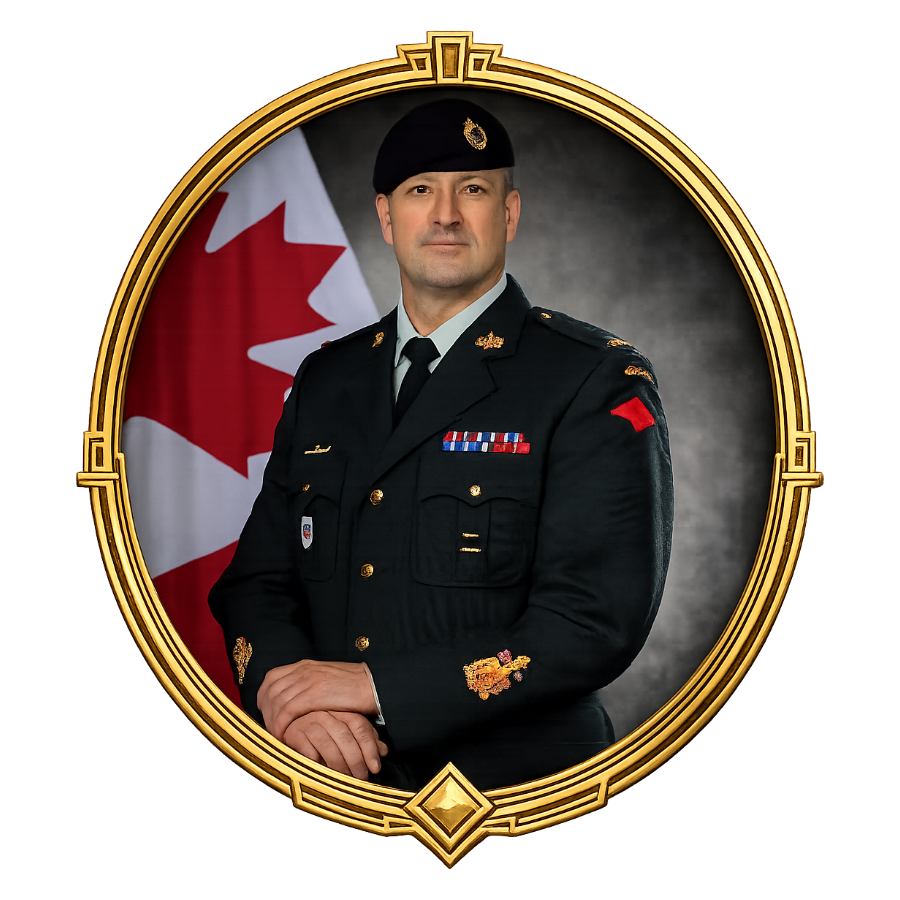
More than three decades of Canadian Armed Forces service, retiring as Chief Warrant Officer — spanning tactical and strategic military communications, from combat operations to national doctrine, with deployments to Bosnia, Afghanistan (Tactical Operations Centre Sergeant, Kandahar) and Poland (Land Task Force Signals lead alongside NATO Baltic allies). He served as the Army G6 Chief Communication Operator and finished as School Chief Warrant Officer of the Canadian Forces School of Communications and Electronics. On Lamassu he is the team’s subject-matter expert for signals intelligence, communications and military operations — central to tailoring the Enkidu stack to DND/CAF requirements.

Portrait of Dan Dorion

Dan Dorion

Project & Program Executive · PMP

A project and program executive with more than twenty-six years leading Canada’s largest government technology transformations — programs exceeding $400M and distributed teams of 100-plus, with a delivery record better than 99% on-time and on-budget across more than a hundred major initiatives.

GW
Gabriel Wainer — portrait to come

Gabriel Wainer

Professor, Carleton University · Simulation Research Lead

A professor in Carleton University’s Department of Systems and Computer Engineering and head of its Advanced Real-Time Simulation Lab, Gabriel Wainer is a leading authority on modelling and simulation — known for his work on the DEVS formalism and real-time, parallel and distributed simulation, with three books and more than 240 papers to his name. On Lamassu he coordinates the university research team building the simulation environment that strengthens the design, bringing experience with US DoD HLA distributed-simulation standards and prior work with DND. He is a Fellow of the Society for Modeling and Simulation International and sits on the editorial board of the Journal of Defense Modeling and Simulation.

Where the work goes next

09 — Beyond the phase
Next phase

Component 2 — build

Entering at TRL 6 with a build-ready design package. The build carries Lamassu through TRL 7 — a controlled pilot in an actual operational environment — to TRL 8: the technology qualified in final form against operational requirements.

Transition & dual use

One platform, many missions

Urban counter-UAS, critical-infrastructure anomaly detection and environmental early warning — and the same governed platform extends to summit security, public safety and allied urban operations, deployable across any city without new procurement.

Intellectual property

Canadian-owned

IP is Canadian-owned and retained by the innovator, with Crown rights per the IDEaS contract terms; the sovereign-capability objective is served by the IP staying in Canada.

Enkidu

Discuss the Lamassu programme

Request a technical briefing, or read the conceptual architecture the proposal builds on.

Request a briefing The Defence sector