Home/Sectors/Defence/Northwind — IDEaS Proposal
IDEaS Competitive Projects · CFP 006

Northwind

Compliance-enforcing AI sensor fusion at the tactical edge — a Canadian-owned intelligence fabric that authenticates, tags and enforces classification, law and coalition policy at machine speed, from the dismounted soldier to the task-force headquarters.

One-page placemat PDF PPTX
Northwind
Sensor Fusion
Reliable AI — CFP 006 challenge
1b — Design
Component · TRL 4 → 6
12 months
Design phase · Aug 26 – Jul 27
Protected B
Design-phase simulation
Sovereign
Canadian-owned IP

Executive summary

01 — In brief

When intelligence from drones, radars, acoustic sensors and radios is fused across security domains, a single error — a track released to the wrong partner, a video stream that reveals a source — can compromise sources, methods or operations. Today that risk is managed by manual review and checklists that cannot keep pace with machine-speed fusion, so intelligence arrives late, degraded, or not at all for the soldier who needs it.

Northwind is a Canadian-owned answer: a software fusion-and-compliance layer that rides the CAF’s existing networks and delivers a policy-enforcing intelligence fabric from the dismounted soldier to the task-force headquarters. Every datum is authenticated, tagged and bound to machine-readable policy from first touch; every enforcement action — permit, restrict, downgrade, segregate — executes programmatically, is recorded in a tamper-evident custody chain, and is explained to the operator in one readable line.

What is new

Compliance as architecture rather than an add-on. The Tangram policy fabric and the Origi trust harness make governance a property of the pipeline itself, at edge size, weight and power.

Validated at TRL 4, we propose the Component 1b design phase: prototype-driven retirement of architecture risk, a simulated operational environment with an independent compliance oracle, and a system-prototype demonstration of a coalition-release scenario — exiting at TRL 6 with a build-ready design.

Fusion that can be trusted with the law, at machine speed

02 — The challenge

The challenge is not fusion — it is fusion that can be trusted with the classification guide and the coalition agreement at machine speed. When UAS video, acoustic arrays, SIGINT receivers, EO/IR platforms and radar are combined across classification domains, the compliance decisions today sit with people: release officers, procedural checklists, and reviews at the speed of a staff cycle. A single cross-domain error can compromise sources, methods or operations; the safe failure mode is to withhold — which starves the tactical edge of exactly the intelligence being collected for it.

The moment matters: the CAF Digital Campaign Plan, the DND/CAF AI Strategy and NORAD modernization all assume AI-enabled fusion at the edge, and none is achievable while compliance remains manual. Canada currently has no home-grown, Canadian-controlled engine for this seam — the sovereignty gap is part of the problem statement.

Who it serves
All-source analystASSIC
Section commanderATAK
Accreditation authorityAudit
Strategic anchors
CAF Digital Campaign Plan · DND/CAF AI Strategy · NORAD modernization · Cyber Forces mandate

A compliance engine inside the fusion path

03 — The proposal

Northwind is a software-defined fusion-and-compliance fabric that runs on commercial off-the-shelf edge compute and rides existing CAF bearers. Four tiers scale from a soldier-carried node, through combat-team and battle-group hubs, to a Forward Operating Base Intelligence Fusion Centre beside the Task-Force HQ.

Every datum traverses a nine-stage ingestion pipeline. Each input is authenticated and content-inspected, then normalized into the Northwind Observation — a tagged object carrying source sensor, time and location, classification with caveats and a Protected B flag, reliability, and a pointer into a signed, hash-linked custody chain. Policy comes from two live frameworks in Tangram — zone policy set at deployment, mission-continuum policy bound at instantiation — and the Origi trust harness resolves them per action, deterministically.

Downgrade is a transformation, not a veto: the pipeline emits a releasable derivative — masked imagery, extracted structured text in the recipient’s format, re-marked classification — recorded as a child of the unreleased parent, so lineage survives release. Under any load, nothing moves untagged, unauthenticated or unrecorded.

The enforcement vocabulary
Permit Restrict Downgrade Segregate

Each disposition executes programmatically for predefined conditions, and is recorded with the exact policy version that produced it.

Validation without government data

DND/CAF supplies no data, and the plan assumes none. A five-layer simulation environment — emulated fabric, synthetic sensors with versioned ground truth, and an independent compliance oracle that checks every enforcement decision — becomes the standing verification harness carried into the build phase.


Built on the Enkidu edge-AI stack

04 — Building blocks

Northwind composes the Enkidu platform. Two frameworks are in scope for this design phase; two companion subsystems sit beyond it — designed and specified in their own architectures, and shown here so DND can see the full system Northwind grows into.

In scope · this design phase
Tangram
The policy fabric

The zoning layer that bounds each operation to a physical zone and a logical continuum — the machine-readable policy Northwind enforces, updated live without a restart.

Explore Tangram →
Origi
The trust harness

The Trust Assurance Framework — policy-based, evidence-backed, provenance-tracked trust that resolves every enforcement action and captures the chain of custody behind it.

Explore Origi →
Beyond this phase · companion architectures
Helios GridOut of scope
The control plane

Enrolment, model and policy rollout, fleet health and remediation across the distributed estate. Not built in this phase — its interface assumptions are pinned as fixed inputs. Referenced for the full-fleet picture.

See Helios Grid →
Aegis DefenceOut of scope
The secure-comms layer

The quantum-resistant cryptographic layer — hybrid post-quantum key establishment and the signature roles across the stack. Custody signing benchmarks use its designated algorithms as a fixed assumption; the cryptography itself is designed elsewhere.

See Aegis Defence →

What is new, and why it wins

05 — Innovation
a

Compliance by construction

A two-framework live policy model, a trust harness composing identity, trust zones and LLM guardrails on edge silicon, and structural lineage — every fused or released object points to its parents, so provenance is a property of the data, not a log that hopes to keep up.

b

Enforcement at the edge

Enforcement moves from the headquarters boundary into the fusion path itself, at machine speed, on soldier-portable hardware. A coalition-caveat change becomes a policy version bump in minutes; under overload the system degrades its picture, never its governance.

c

A sovereign foundation

The Observation and policy schemas are candidates for reuse across Joint ISR, Maritime Domain Awareness and NORAD-facing fusion; the compliance-oracle methodology is a reusable way to generate accreditation evidence — and the stack is Canadian-owned IP.

The CFP 006 “must” list — met by design

06 — Essential outcomes

A modular AI component that enforces classification and policy rules during multi-sensor (≥2) fusion.

Enforcement from machine-readable policy across ≥2 modalities, ≥1 security domain, classification ≥ Protected B.

Compliance checks run programmatically during ingestion and fusion — no human approval for predefined conditions.

Provenance for all ingested and produced data — source sensor, classification, timestamp, domain of origin.

Audit logs of rules applied, enforcement actions (permit / restrict / downgrade / segregate) and dispositions.

Audit records giving data-lineage traceability, exportable for compliance, forensic and accreditation use.

Build to decide: four milestone stages, four gates

07 — Work plan

A prototype-driven design phase on one rule: no critical design claim without measured evidence. Work runs as four equal three-month milestone stages, each closing in a deliverable the Technical Authority can assess. A viability trio — the compliance path at line rate, the custody chain at affordable cost, and live policy resolution — is gated as a go/no-go kill criterion before the majority of spend. The phase ends with an operator-witnessed vertical slice: real sensor in, policy enforced, derivative out to ATAK, audit exported and independently verified.

Stage 1 · M1–M3Aug–Oct 26

Mobilize

Testbed and tier hardware commissioned; CI live; v0.9 schemas; simulation v0 end to end; Carleton activated — and the viability rigs standing with first measurement runs.

Gate G0 · month 3G0 package accepted; rigs standing with first runs recorded.
Stage 2 · M4–M6Nov 26–Jan 27

Viability

The viability trio in full on tier hardware — the compliance path, custody core, and two-framework policy resolution — with measured envelopes published.

Gate G1 · go/no-goThe kill criterion: trio exit criteria met, or the architecture is revised before further spend.
Stage 3 · M7–M9Feb–Apr 27

Design baseline

Breadth prototypes and the detailed design specifications, written from prototype evidence; simulation environment v1.

Design baseline · month 9Evidence-based design baseline closes the stage; simulation v1 accepted.
Stage 4 · M10–M12May–Jul 27

Slice & handover

Peer review consolidated, then the integrated vertical slice — three nodes, a hub and an FOB-IFC surrogate running the coalition-release scenario live — and handover.

Gates G2 & G3 · build entryDesigns peer-reviewed (G2); slice witnessed, audit independently verified (G3).

Milestone stages are quarterly and fixed; gate criteria do not flex.

Team & capability

08 — Who delivers it

Northwind is led by the senior Miovski Group bench — practitioner-architects who authored the frameworks it is built on — resourced with a small, senior delivery team and a supervised agent fleet.

Portrait of Vasil Miovski

Vasil Miovski

Founder · Author of Origi · Co-author of Tangram

An enterprise and business-transformation architect with more than thirty years of international experience across the public and private sectors — including collaborative initiatives with Five Eyes partner agencies. He has led digital transformations from $15M to $350M and beyond for CBSA, ECCC, Shared Services Canada, FINTRAC and Transport Canada, and now leads Miovski Group’s expansion into governed intelligence at the edge.

Portrait of Mark Mintz

Mark Mintz

Enterprise & AI Architect · Co-author of Tangram

More than thirty years turning organizational complexity into measurable results, with rare hands-on depth in AI — building neural networks, genetic algorithms and production expert systems since 1996. At the CRA he designed a neural network to identify high-potential audit targets, surfacing an estimated $1 billion in potential recovery. Co-author of the Tangram architecture.

Portrait of Simon Jobin

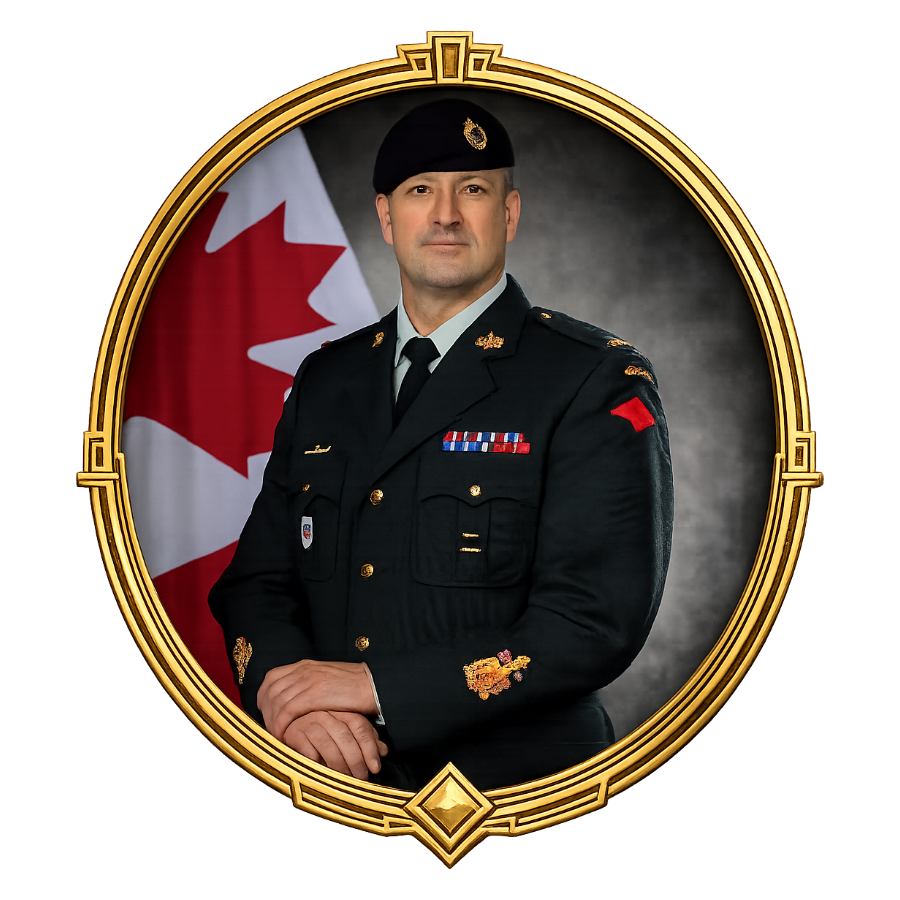
Simon Jobin, CD

CWO (Ret’d), CAF · SIGINT & Operations SME

More than three decades of Canadian Armed Forces service, retiring as Chief Warrant Officer — spanning tactical and strategic military communications, from combat operations to national doctrine, with deployments to Bosnia, Afghanistan (Tactical Operations Centre Sergeant, Kandahar) and Poland (Land Task Force Signals lead alongside NATO Baltic allies). He served as the Army G6 Chief Communication Operator and finished as School Chief Warrant Officer of the Canadian Forces School of Communications and Electronics. On Northwind he is the team’s subject-matter expert for signals intelligence, communications and military operations — central to tailoring the Enkidu stack to DND/CAF requirements.

Portrait of Dan Dorion

Dan Dorion

Project & Program Executive · PMP

A project and program executive with more than twenty-six years leading Canada’s largest government technology transformations — programs exceeding $400M and distributed teams of 100-plus, with a delivery record better than 99% on-time and on-budget across more than a hundred major initiatives.

GW
Gabriel Wainer — portrait to come

Gabriel Wainer

Professor, Carleton University · Simulation Research Lead

A professor in Carleton University’s Department of Systems and Computer Engineering and head of its Advanced Real-Time Simulation Lab, Gabriel Wainer is a leading authority on modelling and simulation — known for his work on the DEVS formalism and real-time, parallel and distributed simulation, with three books and more than 240 papers to his name. On Northwind he coordinates the university research team building the simulation environment that strengthens the design, bringing experience with US DoD HLA distributed-simulation standards and prior work with DND. He is a Fellow of the Society for Modeling and Simulation International and sits on the editorial board of the Journal of Defense Modeling and Simulation.

Key resources · design phase (to be named)

Technical Lead

Rig A · Pipeline & custody

Owns the compliance-path and custody prototypes and the pipeline detailed design.

Policy & Trust Lead

Rig B · Tangram & Origi

Owns two-framework policy resolution and the trust-harness composition.

Integration Lead

Sensors · ATAK · gateways

Owns the external seams — adapters, ATAK/CoT, and the CDS and TDL surrogates.

Simulation & Test Lead

Oracle · fabric · KPIs

Owns the simulation environment and the independent compliance oracle.

Security & Accreditation Lead

DITSR · controlled goods · from stage 2

Owns the accreditation pathway and the evidence pack aligned to sim outputs.

External partners & advisors
Carleton University Simulation Labs

Advanced Real-Time Simulation Lab and V-Sim Centre — DEVS-based modelling and distributed simulation that strengthen and independently verify the design.

Cognitive scienceProposed

A university team on trust-calibration and the operator-comprehension protocol; decided at G0.

Where the work goes next

09 — Beyond the phase
Next phase

Component 2 — build

Entering at TRL 6 with a build-ready design and the simulation harness as the standing verification gate. Build targets TRL 7–8: field-representative trials and swap-in of the accreditation-gated devices behind interfaces already validated against surrogates.

Transition & dual use

Fielded, and beyond

The LCSS-integrated profile is designed to pilot with an existing formation, without new networks or radios. The same policy-enforcing fusion applies to multi-agency public safety, critical-infrastructure monitoring and regulated-industry data governance.

Intellectual property

Canadian-owned

IP is Canadian-owned and retained by the innovator, with Crown rights per the IDEaS contract terms; the sovereign-capability objective is served by the IP staying in Canada.

Enkidu

Discuss the Northwind programme

Request a technical briefing, or explore the frameworks and the Defence sector the proposal builds on.

Request a briefing The Defence sector